The Galaksija Cup is Serbia's premier national competition for electrical engineering and computer science students in robotics, electronics, and software innovation, organized by the Association of Electrical Engineering Schools of Serbia (ZETŠS) and the Nordeus Foundation. Its jubilee 10th edition gathered the top secondary school STEM finalists nationwide.
Autonomous Edge AI Vehicle
An open-source hardware and software platform for the practical deployment and research of on-device Edge AI computer vision on Raspberry Pi 5 architecture.
Competition Success & Recognition
National STEM and robotics innovation championship
The Smart Vehicle project earned 4th place overall in a competitive field of national finalists, accompanied by a Special Award for Outstanding Achievement. The evaluation jury specifically recognized the decoupled modular architecture, real-time on-device Edge AI inference, and containerized deployment.
Motivation & Concept
Bridging theoretical foundations with real-world engineering challenges
The Educational Gap
Traditional computer science education frequently emphasizes theoretical algorithms in isolated software sandboxes. Students often miss hands-on exposure to physical hardware where they must manage dynamic real-world variability, signal latency, and constrained memory budgets.
Project Mission
Smart Vehicle provides a production-grade playground for real-time computer vision and optical character recognition. By eliminating tedious driver and dependency configuration hurdles, it enables direct exploration of robotics motor control, data pipelines, and telemetry.
Architectural Solutions
During early development, coupling synchronous computer vision loops with motor drivers caused blocking and latency spikes. This was resolved by adopting decoupled Docker microservices, multithreaded pipelines, and an automated watchdog script for self-healing network connectivity.
Hardware Architecture
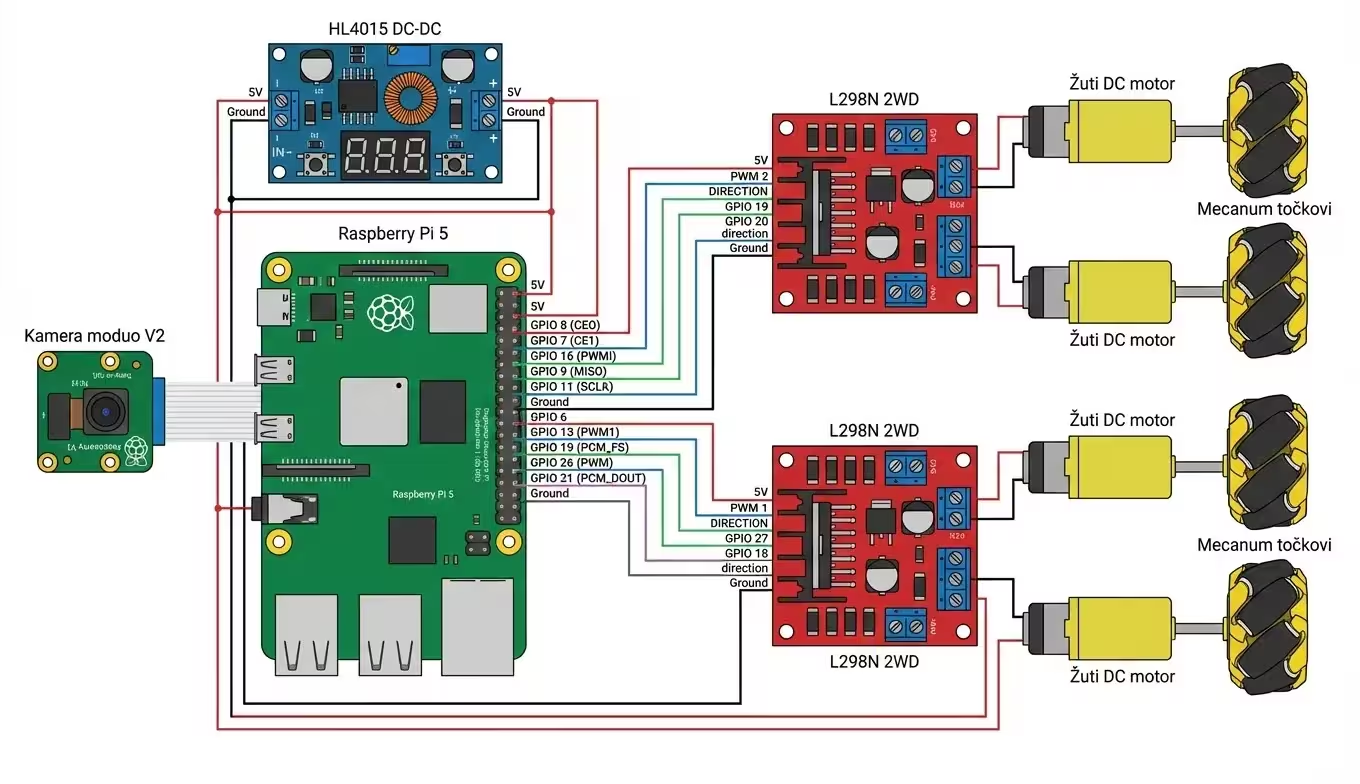
Overview of core physical modules and component interconnects
An XL4015 Step-down DC-DC buck converter (5.1V, 5A) guarantees stable, uninterrupted voltage delivery to the Raspberry Pi 5 under heavy continuous inference workloads.
Four independent DC geared motors paired with Mecanum wheels enable full holonomic (omnidirectional) movement and millimeter-precision positioning.
A Raspberry Pi Camera Module v2 (8MP) linked via dedicated MIPI CSI-2 hardware interface delivers high-framerate, low-latency video streaming.
Software Architecture Layer
Decoupled software stack designed for real-time edge processing and autonomous control
YOLO AI Model
Optimized neural network inference pipeline processing 30 FPS camera feeds, performing real-time roadway object detection (5–10 FPS) and continuous multi-target tracking.
Google ML Kit OCR
On-the-fly optical text extraction from road signs and instructional markers, featuring automatic rotation correction and execution of recognized commands.
Multithreaded Pipeline
Asynchronous, parallel execution separating the camera acquisition thread, AI inference worker, and hardware PWM motor duty cycles to avoid frame drops.
Dockerized Environment
Isolated microservices for the server and network watchdog eliminate host OS dependency collisions and provide rapid error recovery.
GitHub Actions CI/CD
Automated linting, unit testing, and container build validation on every push ensure stability throughout continuous software development.
Docker Hub Registry
Centralized container registry hosting pre-built multi-architecture images enables one-command deployments on any fresh Raspberry Pi device.
Modular Ecosystem Repositories
Source code is open-source and modularized into focused repositories
RPi Server
Primary backend microservice. Manages GPIO peripherals, YOLO object detection inference, and low-latency MJPEG video streaming.
Smart Network
Self-healing network daemon. Monitors Wi-Fi connectivity and automatically activates a fallback local Wi-Fi Hotspot whenever external networks drop.
Model Pipeline
Optimization, quantization (INT8/FP16), and export workflows transforming YOLO models for hardware-accelerated edge inference.
Android Client
Primary operator dashboard. Provides real-time Mecanum drive controls, low-latency FPV video playback, and live telemetry overlay.
Web Dashboard
Modern web monitoring interface allowing remote vehicle telemetry inspection and analytics directly within any web browser.
RPi Server (Legacy)
Initial prototype backend based on bare-metal Linux systemd daemons and native WebSockets messaging.
Applications & Use Cases
From foundational STEM robotics education to real-world automation scenarios
Education & STEM R&D
An interactive learning platform for exploring edge computing, microservice architecture, sensor fusion, and asynchronous embedded Python development.
Smart Cities & Traffic Analysis
Adaptable for vehicular flow monitoring, license plate extraction, roadway obstruction alerting, and municipal street condition inspection.
Industry 4.0 & Warehouse AGVs
Testbed for Automated Guided Vehicles (AGVs) navigating warehouse floors through visual line-following, ArUco/QR markers, and dynamic obstacle evasion.
Project Gallery
Visual showcase of physical hardware, competitive accolades, and software interfaces
4th Place & Special Award at the 10th Galaksija Cup
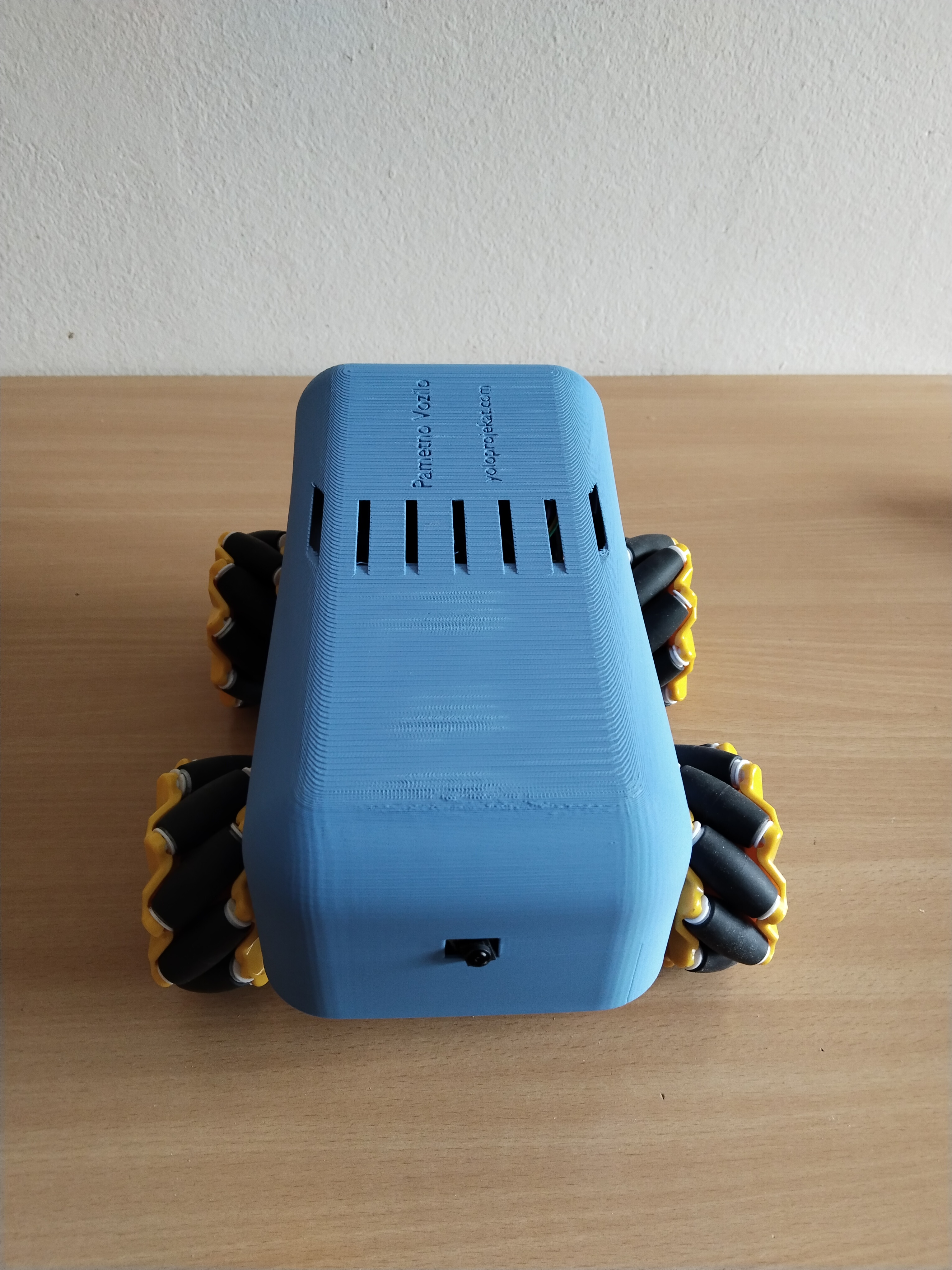
Physical chassis assembly featuring Mecanum drivetrain and sensor array
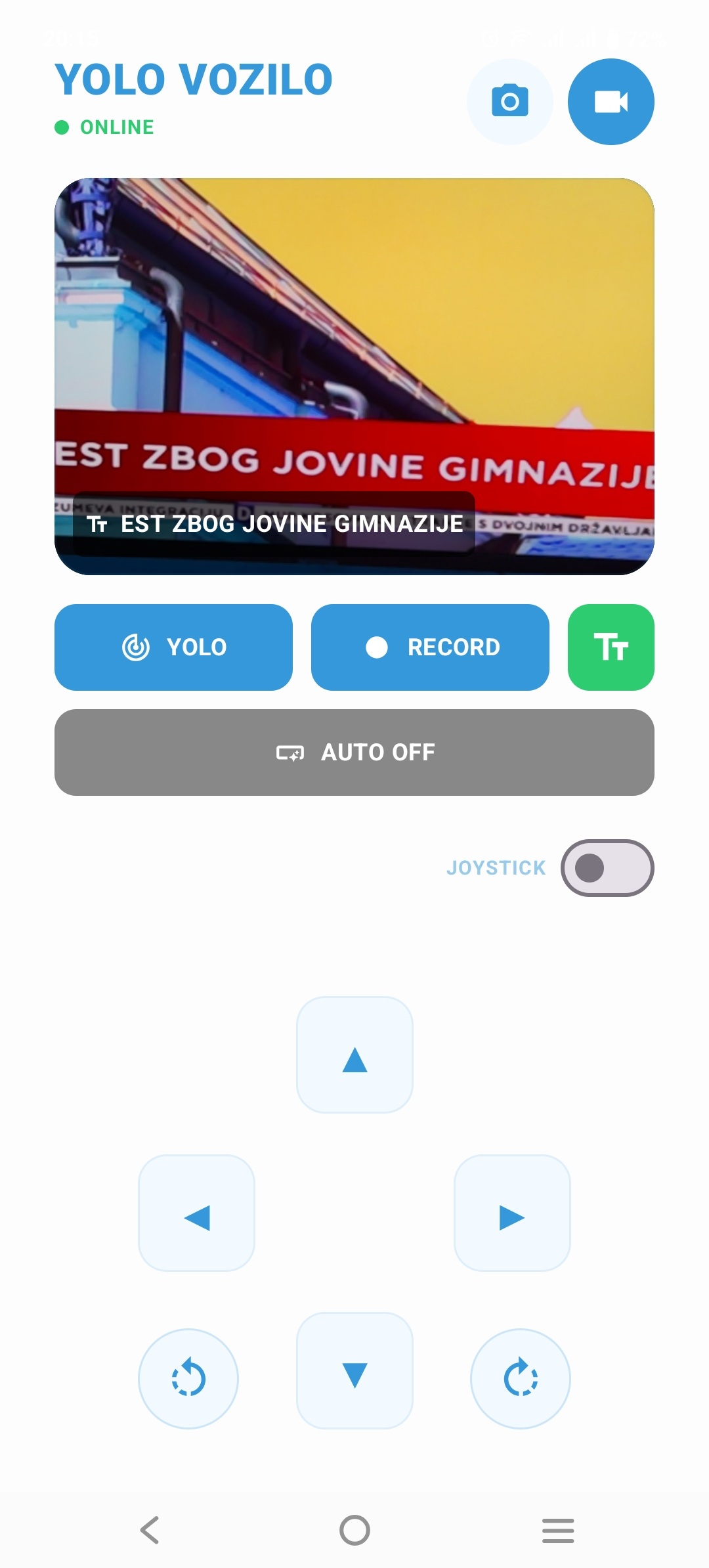
Mobile client interface showing live OCR text extraction
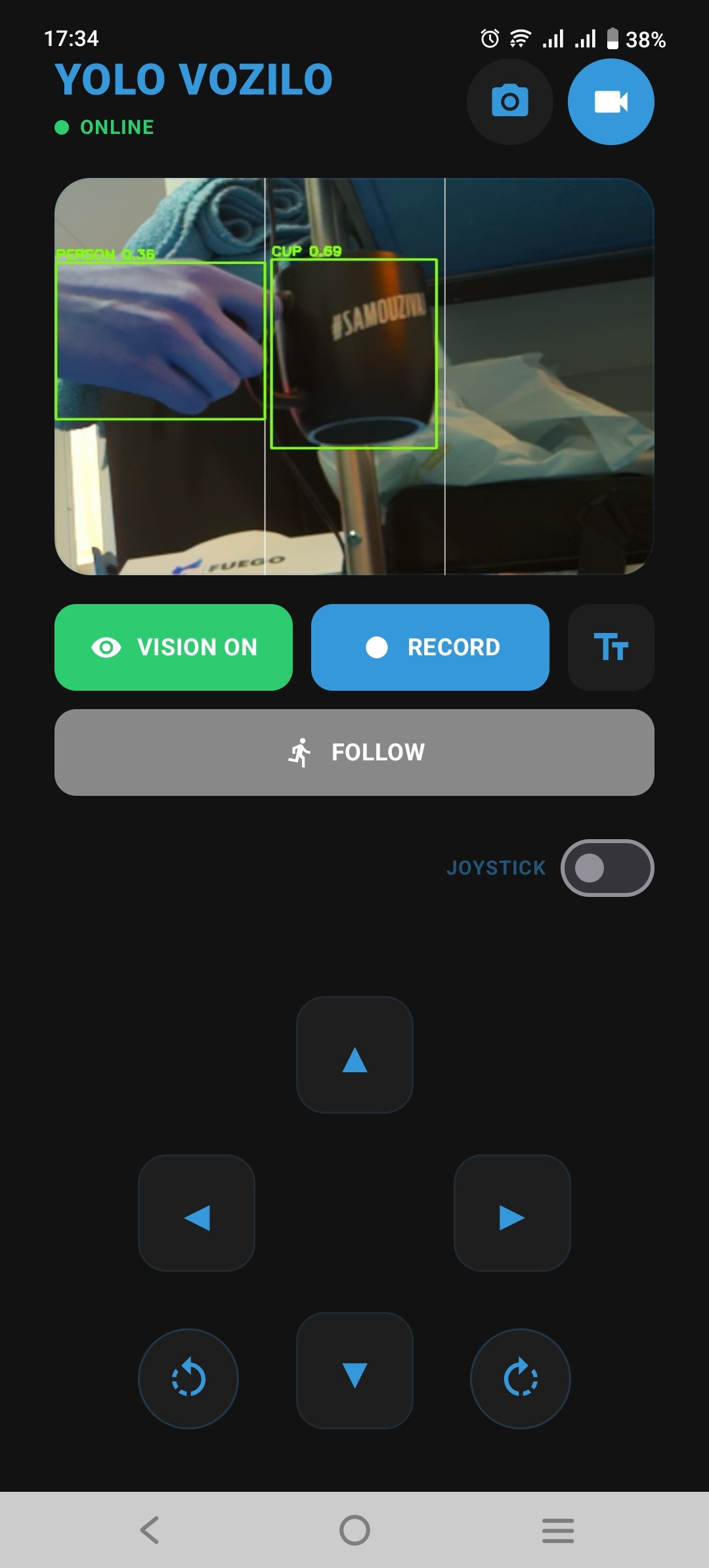
Real-time YOLO object detection and bounding box telemetry stream
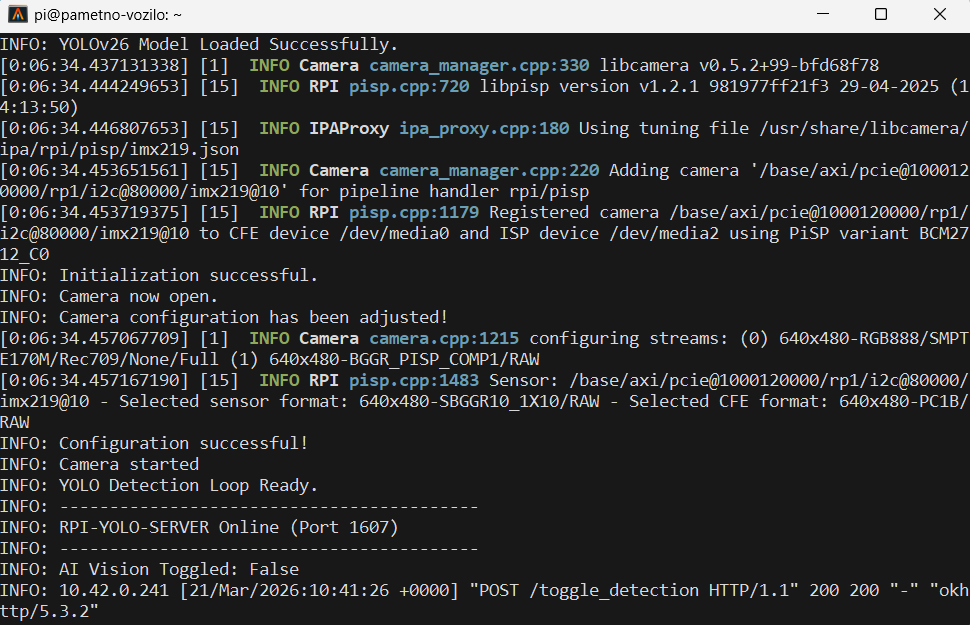
Containerized system logs running on Raspberry Pi 5 under Docker
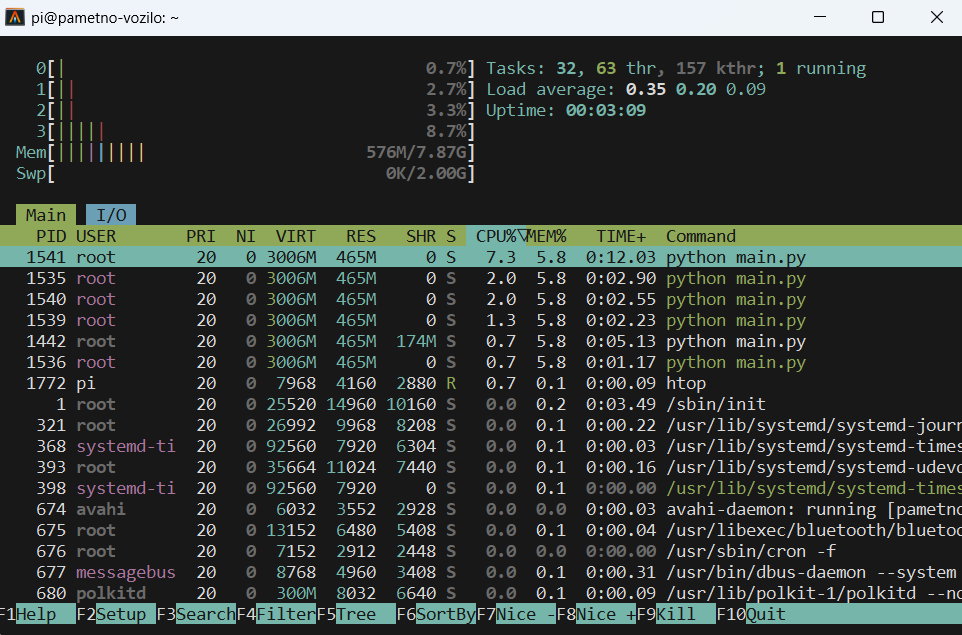
Live resource monitor (htop) tracking CPU cores and memory footprint
Project Development Roadmap
Chronological evolution from initial prototype to future autonomous milestones
Phase I: Prototype & Basic Control
Fundamental verification of hardware and mechanics:
- Hardware: Chassis assembly and baseline 4WD differential drive.
- Communication: Manual teleoperation via static Wi-Fi hotspot.
- Video Stream: Direct FPV camera capture pipeline.
- Software: Early client prototype and synchronous Python scripts.
- AI Model: Initial feasibility benchmarking with YOLOv8.
Phase II: Modular Architecture & Recognition
System stabilization, containerization, and competitive recognition:
- Competitive Success: Won 4th place and Special Award at the 10th Galaksija Cup.
- Refactoring: Microservices architecture powered by Docker Compose.
- AI Vision: Multi-model pipeline featuring YOLO and Google ML Kit OCR.
- Network Reliability: Self-healing daemon with automatic fallback hotspot.
- Client App: Modern Jetpack Compose Android UI with low-latency streaming.
- Open Source: Publicly released on GitHub under the permissive MIT license.
Phase III: Advanced Autonomy
Expanding autonomous capabilities and curriculum adoption:
- Educational SDK: Block-based visual programming API for beginner STEM students.
- Sensor Fusion: Integration of 2D/3D LiDAR with SLAM mapping algorithms.
- Standardization: Comprehensive replication blueprints and open hardware schematics.
Comparison: Theory vs. Practice
Analyzing the contrast between traditional classroom learning and production-grade engineering
Dry Theory
Focus on memorizing syntax on paper without the ability to execute code, diagnose runtime exceptions, or navigate physical hardware limitations.
Disconnected Sandbox
Solving artificial textbook problems isolated from network latency, packet drops, CPU thermal throttling, and hardware memory ceilings.
Production-Grade Systems
Accelerated engineering growth achieved through live problem solving, Docker microservices, on-device Edge AI models, and open-source collaboration.